
The Investment Case
Why Gurugram Property Pays You Twice, And Your FD Only Once
Between 2019 and 2026, the average Gurugram flat went from ₹6,150 a square foot to ₹13,350. It collected rent every month along the way. Here is the honest maths, including where property loses.
Dronacres advisory desk · 9 minute read
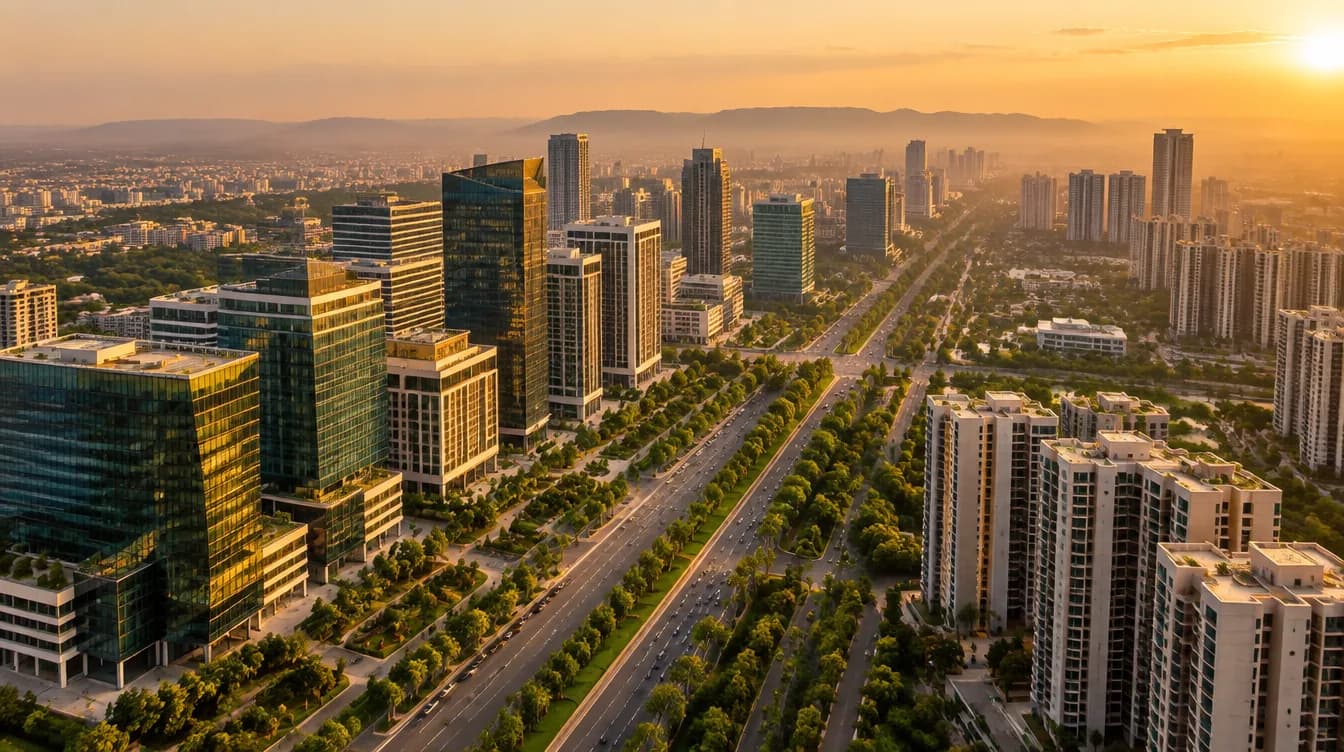
Gurugram at golden hour. In seven years the average home here has more than doubled in value, while the rent it earns has risen too.
1. The number that started this article
In 2019, the average home in Gurugram cost about ₹6,150 for every square foot.
By the middle of 2026, that same square foot cost about ₹13,350.
That is a rise of roughly 117 percent in seven years. A ₹1 crore flat bought in 2019 would be worth close to ₹2.17 crore today.
But that is only half the story, and it is the half everybody already knows. The more interesting half is that the flat was also earning rent that entire time.
2. What "pays you twice" actually means
Most places you put money pay you in one way only.
A fixed deposit pays you interest. That is it. The ₹1 crore you put in stays ₹1 crore.
Gold goes up in value. That is it. It sits in a locker and earns nothing while it waits.
Property is unusual because it does both at the same time.
First payment: the value goes up. This is called capital appreciation. It is simply the flat being worth more than you paid for it.
Second payment: the rent comes in. Every month, someone else pays you to live in it. In Gurugram that rent works out to roughly 4 to 6 percent of the property's value each year in good locations, and 5 to 7 percent on quality stock along Sohna Road. Seven years ago the city average was 3.5 percent. Today it is about 4.3 percent.
That second number is worth pausing on. Rents usually fall as prices rise, because the price runs ahead of what tenants can pay. In Gurugram since 2019, prices went up and rental yields went up. Both engines fired at once. That is not normal, and it is the clearest signal that real demand, not speculation, is driving this market.
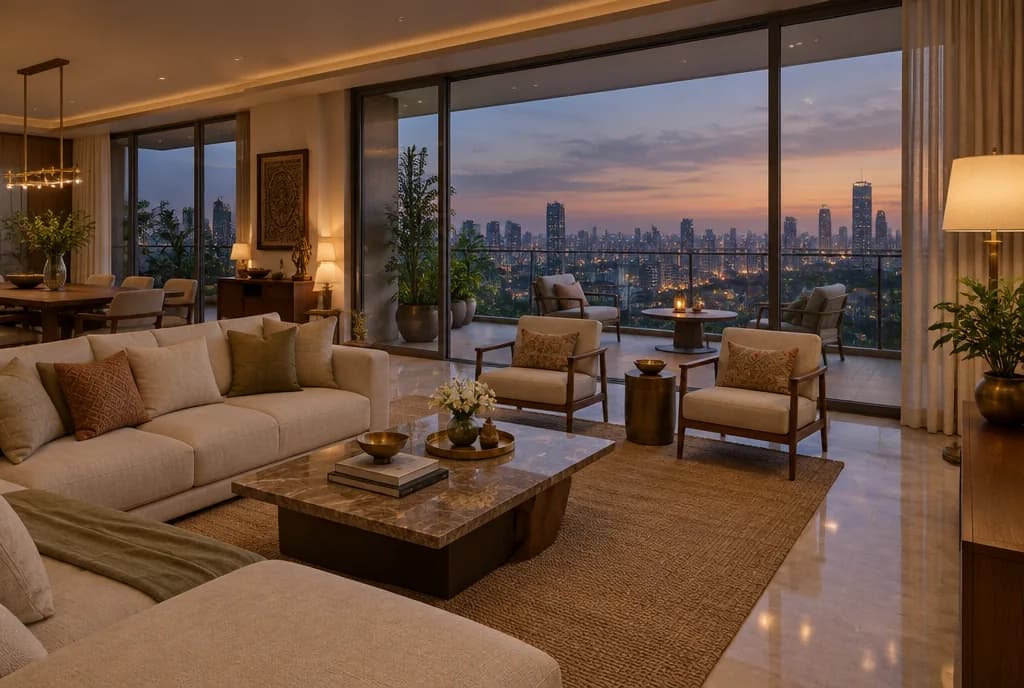
The same flat doing two jobs at once: growing in value, and collecting rent from a tenant every month.
3. How it compares with an FD, gold and shares
Here is the honest comparison. Take ₹1 crore in 2019 and see where it lands seven years later.
| Where you put it | Roughly worth in 2026 | Did it also pay you along the way? |
|---|---|---|
| Fixed deposit at 6.5 percent | About ₹1.37 crore after tax | No, the interest is the return |
| Gold, at its long-run average | About ₹2.08 crore | No |
| Nifty 50, at its long-run average | About ₹2.08 crore | Small dividends only |
| Average Gurugram flat | About ₹2.17 crore | Yes, roughly ₹30 lakh in rent |
How we calculated this
- Fixed deposit: 6.5% compounded annually for 7 years, then 30% tax on the interest earned.
- Gold: 11% long-run CAGR, compounded over 7 years.
- Nifty 50: 11% long-run CAGR on price, plus a thin layer for dividends at roughly 1.3% a year.
- Gurugram flat: 117% total capital growth over the 7 years (the ANAROCK-reported 2019–2026 figure), plus rent averaging roughly 30% of the amount invested, collected cumulatively over the same period.
- Figures are indicative and rounded. They illustrate the shape of the comparison, not a guarantee.
Two things to notice.
Property did not crush gold or shares on price growth. They finished close. Anyone telling you property triples your money while everything else sits still is selling you something.
Property won on the rent. That ₹30 lakh of rent is the real difference. It arrived monthly, it rose over time, and it did not require you to sell anything to collect it.
There is also a tax point worth knowing. That fixed deposit looks like 6.5 percent, but if you are in the 30 percent tax slab, you keep only about 4.5 percent of it. The headline rate and the rate you actually receive are different numbers.
4. The part most people miss: borrowed money
This is the section that changes the answer, and almost nobody explains it properly.
You cannot easily borrow money to buy gold. No bank will lend you ₹75 lakh to buy Nifty shares.
A bank will happily lend you ₹75 lakh to buy a ₹1 crore flat.
So run the 2019 example again, this time the way people actually buy property.
You put in ₹25 lakh of your own money. The bank puts in ₹75 lakh. You buy the ₹1 crore flat.
By 2026 the flat is worth ₹2.17 crore. You still owe roughly ₹75 lakh (less, actually, since you have been paying it down). So the part that belongs to you is about ₹1.42 crore.
Your ₹25 lakh became ₹1.42 crore of value that is yours.
Gold and shares cannot do that, because you had to pay for all of them yourself.
Now the honest caveat, because this cuts both ways. You pay interest on that loan, and over seven years it is a large number. If prices fall instead of rise, the loss lands on your ₹25 lakh, not on the bank's ₹75 lakh. Borrowing multiplies whatever happens. It is a powerful tool and a genuinely risky one, and it only makes sense if your monthly EMI is comfortable even in a bad year.
Not sure how much loan you would actually qualify for? Talk to an advisor, not a call centre.
5. Why Gurugram, and not just any city
Property only rises where people want to live, and people live where the jobs are.
The jobs are here, and they are growing. Delhi NCR leased a record 15.8 million square feet of office space in 2025, up 24 percent on the year before. Most of that landed in Gurugram. Global Capability Centres, the offices multinational companies set up in India to run their worldwide operations, now drive 40 to 50 percent of top-grade office demand. These are well-paid, long-term jobs, and the people holding them need somewhere to live.
Three pieces of infrastructure landed almost together.
The Dwarka Expressway is now open, an eight-lane elevated road that is the longest of its kind in the world. It carried about 27 percent of all new homes launched in Gurugram in 2025. A further extension towards Delhi's Mayapuri Ring Road was proposed in May 2026.
The New Gurugram Metro broke ground on 5 September 2026. It runs 28.5 kilometres with 27 stations, connecting HUDA City Centre to Cyber City. Property near new metro lines in Indian cities has historically moved sharply, and analysts expect 15 to 20 percent gains for sectors along this corridor.
Noida International Airport at Jewar started operating on 28 March 2026. A second airport takes pressure off the region and opens up the whole eastern side of NCR.
Roads, metro and an airport arriving inside the same eighteen months is not a small thing. Infrastructure is the most reliable predictor of property prices there is, because it changes how long it takes someone to get to work.
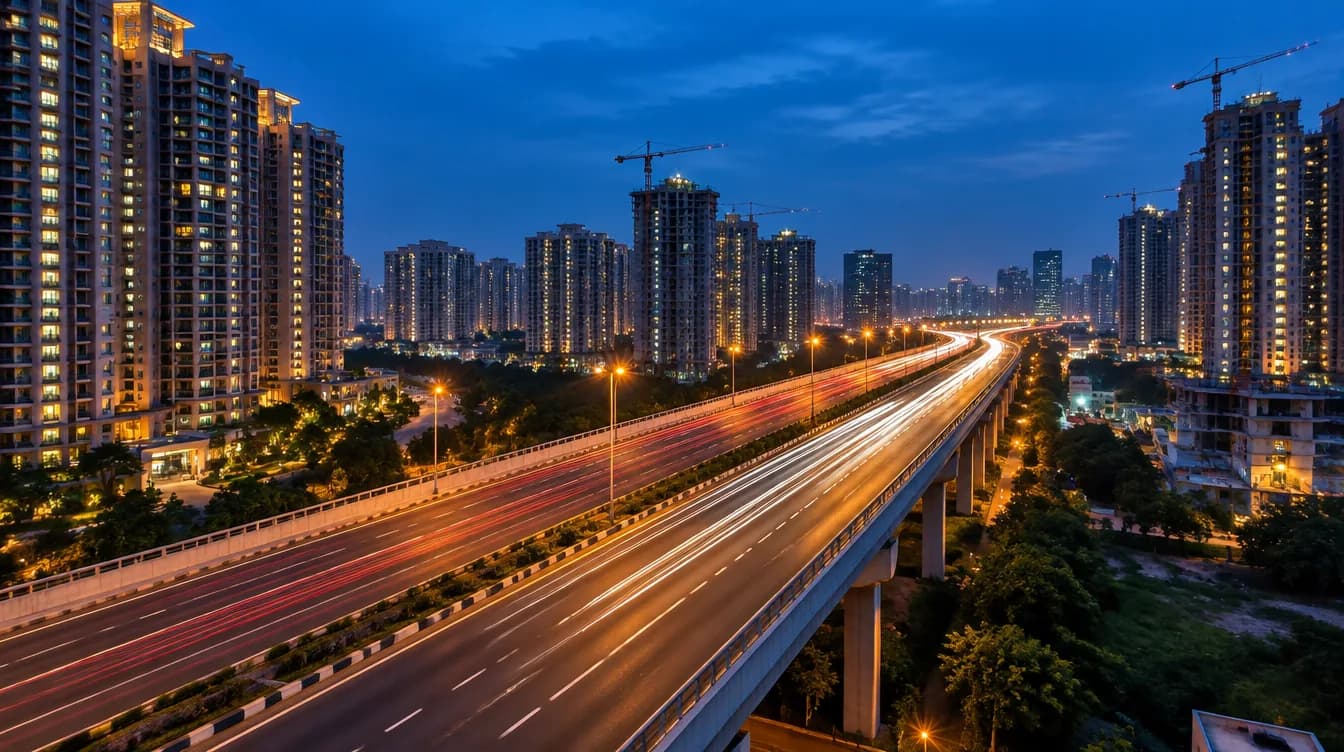
The Dwarka Expressway at dusk. Around 27 percent of Gurugram's new homes in 2025 were launched along this one corridor.
6. Where inside Gurugram
"Gurugram" is not one market. It is five, and they behave quite differently.
The right corridor depends entirely on which of those sentences describes you. Someone buying a family home and someone buying for yield should not end up in the same sector.
7. What can go wrong, honestly
Any article about investing that lists only the good parts is an advertisement. Here are the real risks.
Possession takes years. Most luxury projects launched in 2024 to 2026 quote handover in 2028 to 2031. That is four to six years of paying without receiving. Check the builder's actual delivery record, not their brochure.
Your money is stuck. You can sell a share in seconds. Selling a flat takes months, and if you need the money urgently you will accept a lower price. Never put money into property that you might need soon.
The entry cost is large. Beyond the price you also pay stamp duty and registration, and usually a broker. Budget for those from the start.
Not every project is safe. Before paying anyone a rupee, check the project on the Haryana RERA website at haryanarera.gov.in. Every legitimate project has a registration number. If a seller cannot give you one, walk away. This single check prevents most of the problems people face.
Past growth is not a promise. The 117 percent happened. It does not guarantee the next seven years. The current forecast for 2026 is 8 to 12 percent, which is healthy but slower than the earlier run.
8. What you actually need to start
The most common reason people never buy is that they assume they need the whole amount. They do not.
Monthly EMI
₹65,087
Total interest over the loan
₹81,20,818
Upfront cash needed
₹32,00,000
Down payment plus roughly 7% for stamp duty, registration and paperwork.
Indicative only. Confirm exact terms with your lender.
The usual structure is roughly 20 to 25 percent from you and the rest from the bank. On a ₹1 crore home that is ₹20 to ₹25 lakh, plus about 7 percent for stamp duty, registration and paperwork.
A useful test before you commit: work out the EMI, then ask whether you could still pay it comfortably if your income dropped for six months. If the answer is yes, you are ready. If it is no, wait, save a little longer, or look at a smaller unit in a different corridor. There is no prize for stretching.

For most families the flat is not a line in a portfolio. It is where they live, and it happens to grow in value while they do.
Closing
Property is not magic. It did not beat gold by a wide margin on price alone, it locks your money up for years, and it demands genuine homework before you sign.
What it does, which almost nothing else does, is pay you in two ways at once, in a city where the jobs, the roads, the metro and now a second airport all point the same direction.
That is the case. The rest depends on your money, your timeline and which corridor actually suits you, and that is a conversation, not an article.
Tell us your budget and what you want it to do. We will tell you honestly whether Gurugram is the right answer for you.